Price fades. Delivery compounds.
When you're small and hungry, there's one lever that always feels available: price.
Can't match their brand? Go cheaper. Not sure you'll win the pitch? Drop the number. Someone's hesitating? Knock off another ten percent.
It works. That's the trap. It works just often enough that you keep reaching for it — until you look up a year later and realise you've built an entire business on the one thing that doesn't last.
Let me explain what I mean.
Price is a one-time event
Think about the last time you hired someone — an agency, a contractor, a tool. The price mattered on day one. It was the loudest thing in the room. You compared quotes, you negotiated, you picked.
Now fast-forward six months. Do you remember the exact number you paid?
Probably not. What you remember is how it felt. Did they deliver on time? Did the work hold up, or did it quietly fall apart the moment you stopped watching? Did working with them make your life easier, or did you end up doing half the job yourself?
That's the thing nobody tells you when you're competing on price. Price gets you in the door and then it's gone. It does its job in the first week and never comes back.
Delivery is the opposite. It shows up every single day after the contract is signed.
The two lines never cross back
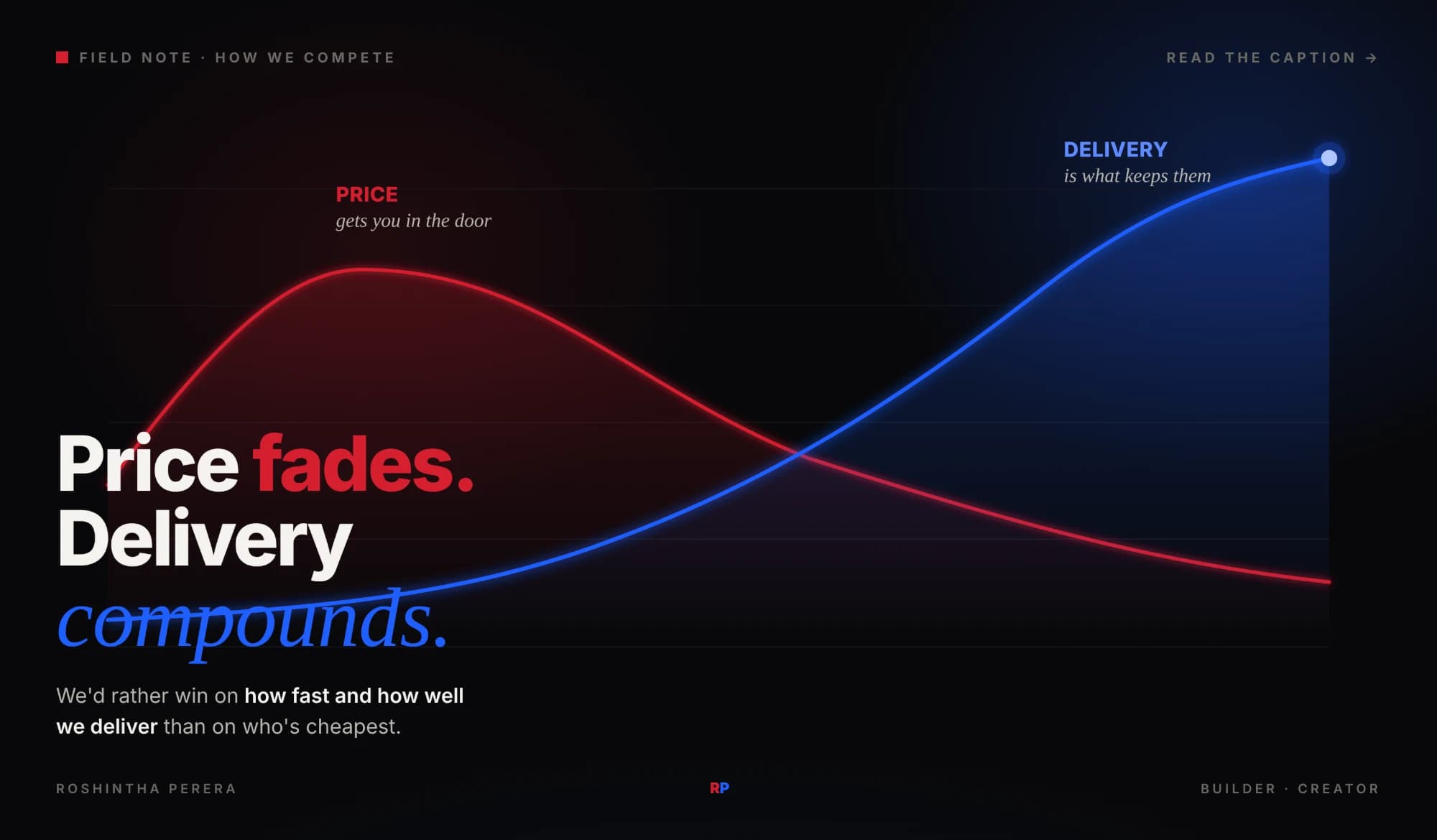
Picture two lines on a graph.
The first is price. It spikes hard at the start — it's the entire conversation on day one. Then it flattens and fades, because nobody renews a contract out of gratitude for a discount. Nobody refers you because you were cheap. The line goes quiet.
The second is delivery. It starts quieter. On day one, nobody's impressed that you say you'll do great work — everybody says that. But then the work starts. Every deadline you hit. Every handoff that's clean. Every problem you solve before the client even notices it's a problem. That line climbs. And it keeps climbing, because delivery compounds into the three things that actually grow a business: trust, referrals, and the next project.
Here's the part that matters. Once those two lines cross, they never cross back. A client who stays because of how well you deliver doesn't leave over price. But a client who came for your price will leave the second someone quotes lower.
So the question isn't really "how do I win this deal." It's "which line am I building my business on."
Cheap attracts cheap
There's a second cost to competing on price, and it's the one that quietly eats teams alive.
When you win on being the cheapest, you attract the clients who chose you for being the cheapest. That's the whole relationship. They optimised for price, so they'll keep optimising for price — more scope for the same money, more revisions, more pressure on your margins, and one eye always on the door for a better rate.
You didn't just win a cheap deal. You trained a client to treat you as the cheap option.
The clients who value delivery are a different species entirely. They're not looking for the lowest number. They're looking for the team that makes the problem go away and keeps it away. And because that's what they want, they're easier to work with, easier to do great work for, and far more likely to stay.
You don't get those clients by being cheaper. You get them by being better, and then proving it, over and over, in how you deliver.
So what do you actually do?
Compete on the things that compound.
- Speed — not rushed, but responsive. The team that answers, moves, and ships while everyone else is still scheduling a kickoff call.
- Reliability — the work holds up. It doesn't break the week after launch. The client stops double-checking because they've learned they don't have to.
- Ownership — you treat the client's problem like it's your own, which means you catch the thing they didn't think to ask for.
None of that shows up on a quote. All of it shows up six months in, which is exactly when price has already been forgotten.
I'd rather win on how fast and how well we deliver than on who's cheapest. Every time. Not because price doesn't matter — it's the cost of entry, and you still have to be in the room. But price is never the reason anyone stays. The reason they stay is that working with you got easier, not harder, the longer it went on.
Build on the line that compounds.
If you've run a small team — did you ever manage to climb out of competing on price? And what actually got you there?